

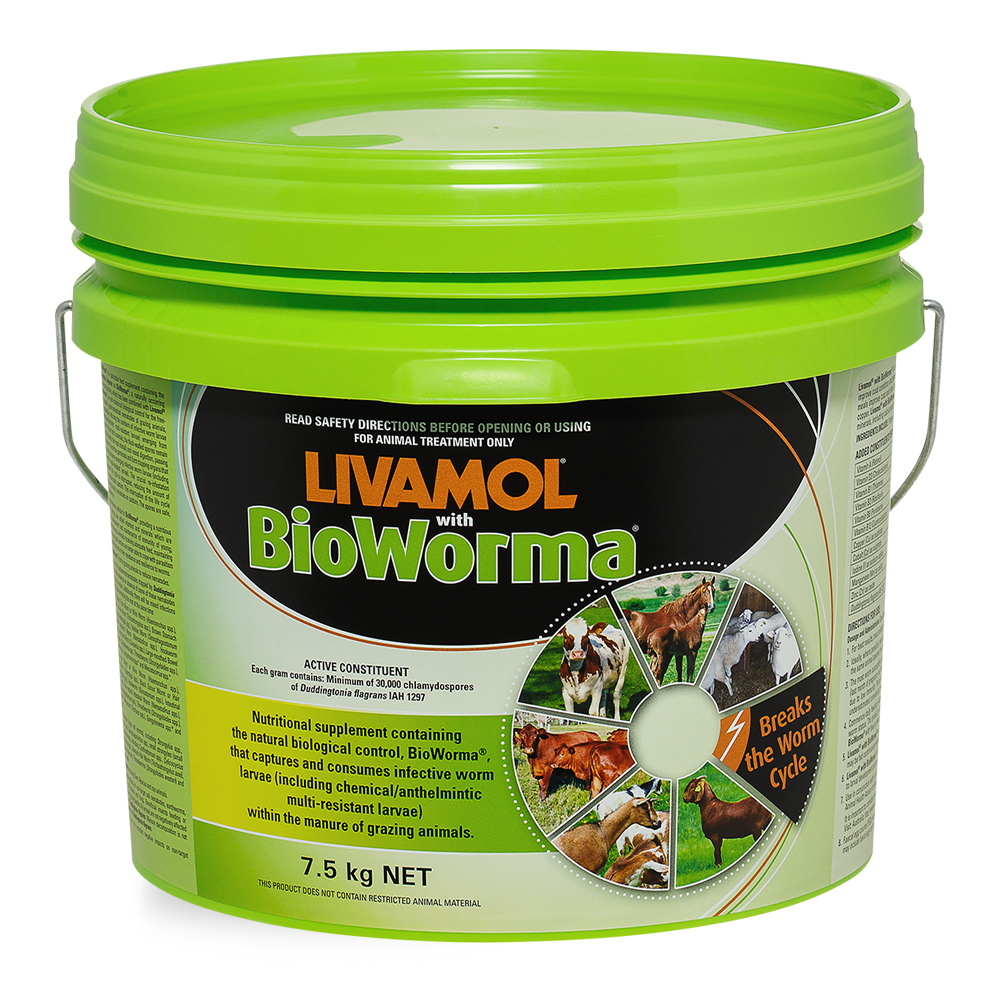
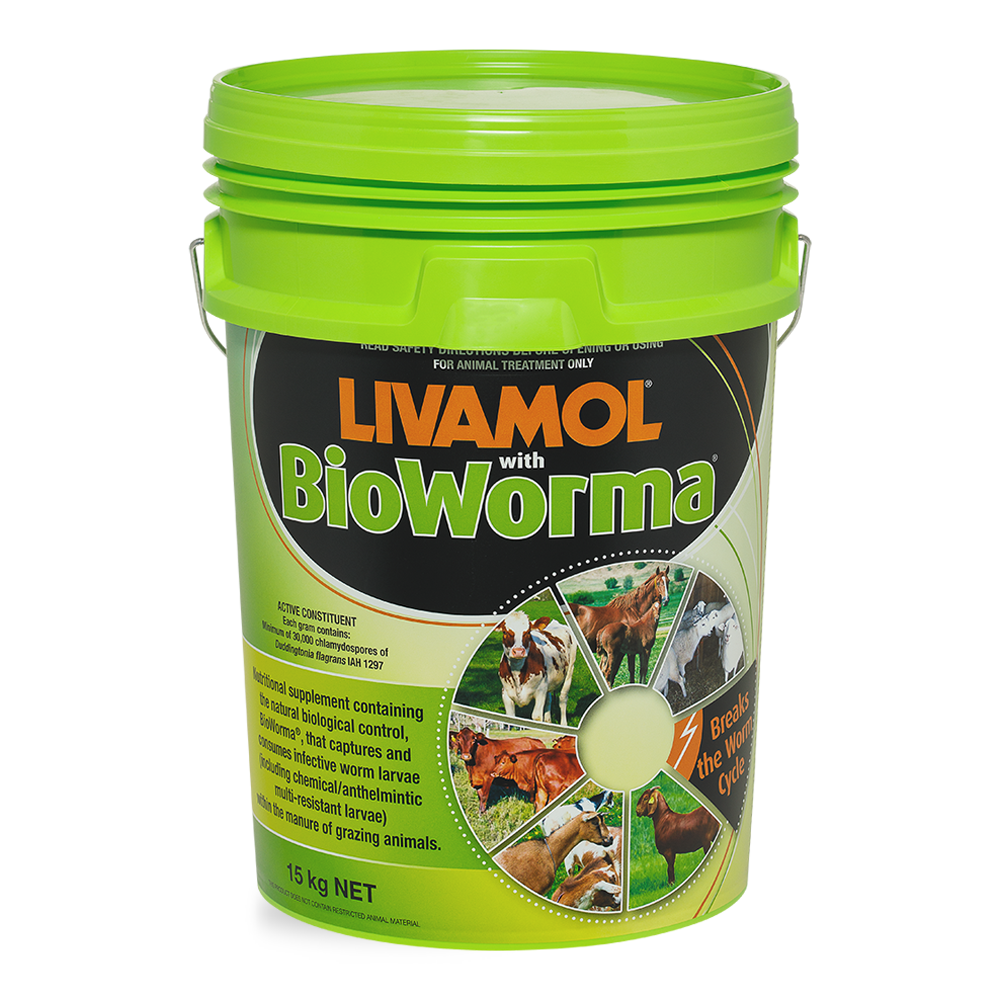
Livamol with BioWorma – Biological Worm Control
Livamol with BioWorma – Nutritional Support & Natural Biological Worm Control
Help break the worm life cycle and reduce pasture contamination naturally.
Livamol® with BioWorma® combines the nutritional benefits of Livamol with an innovative, non-chemical biological control for infective gastrointestinal worm larvae in the manure of grazing animals.
Containing the naturally occurring fungus Duddingtonia flagrans IAH 1297, BioWorma works within manure to capture and consume developing worm larvae before they can migrate onto surrounding pasture.
Unlike conventional chemical wormers, which target parasites within the animal, BioWorma acts outside the horse, helping reduce the number of infective larvae returning to pasture and contributing to improved long-term parasite management.
The Livamol base also provides valuable protein, energy, vitamins and minerals, making this a convenient daily nutritional supplement for horses and other grazing livestock.
Key Benefits
-
Natural biological worm control: Contains Duddingtonia flagrans, a naturally occurring fungus that captures and consumes infective worm larvae in manure.
-
Reduces pasture contamination: Helps limit the number of infective gastrointestinal worm larvae developing in manure and emerging onto grazing pasture.
-
Targets resistant larvae: Acts against susceptible larvae, including those resistant to conventional chemical wormers.
-
Supports integrated parasite management: Complements appropriate chemical worming, faecal egg monitoring and pasture management programmes.
-
Nutritional support: Livamol provides protein, energy, essential vitamins and minerals to supplement the daily diet.
-
Non-chemical action: The fungal spores act outside the animal and are described by the manufacturer as safe, non-toxic and residue-free.
-
Environmentally considerate: Manufacturer testing indicates no negative effects on non-target soil nematodes, dung beetles, earthworms and other beneficial soil organisms.
-
Suitable for multiple grazing species: Can be used for horses, cattle, sheep, goats, alpacas, deer and other grazing animals according to label directions.
-
Convenient daily feeding: A palatable, free-flowing meal that can be mixed with normal feed.
How Does Livamol with BioWorma Work?
BioWorma takes a different approach to conventional worm control by targeting the free-living larval stages of gastrointestinal parasites in manure.
Step 1 – Daily Feeding
Livamol with BioWorma is fed daily at the recommended rate for the animal's bodyweight.
Step 2 – Spores Pass Through the Digestive System
The thick-walled spores of Duddingtonia flagrans survive passage through the digestive tract without acting on parasites inside the animal.
Step 3 – Natural Biological Action in Manure
Once excreted in manure, the fungal spores germinate and develop specialised trapping structures that capture, immobilise and consume developing worm larvae.
Step 4 – Reduced Pasture Contamination
By reducing the number of infective larvae emerging from manure, BioWorma helps interrupt the parasite life cycle and reduce opportunities for animals to become reinfected while grazing.
Regular feeding is important because BioWorma works on larvae developing in manure deposited by animals receiving the supplement. It does not eliminate larvae already present on pasture.
Which Horse Worms Does BioWorma Target?
The manufacturer identifies biological activity against the free-living larval stages of several important equine gastrointestinal parasites, including:
-
Large strongyles (large redworms)
-
Small strongyles (small redworms or cyathostomes)
-
Stomach hair worms
-
Ascarids (roundworms)
-
Threadworms
-
Pinworms
BioWorma acts on susceptible larvae in manure rather than treating established infections within the horse.
Nutritional Benefits of Livamol
Livamol provides a nutrient-rich carrier for BioWorma, supplying:
-
Minimum 20% protein
-
Minimum 5% fat
-
Vitamins A, D3, B1, B2, B6 and B12
-
Calcium and phosphorus
-
Copper, zinc, manganese, cobalt and iodine
-
Average digestible energy of 11 MJ/kg
This combination allows horse owners to provide daily nutritional supplementation while incorporating biological pasture worm control into their management programme.
Active Ingredient
Each gram contains a minimum of 30,000 chlamydospores of Duddingtonia flagrans strain IAH 1297.
This naturally occurring fungus is the active biological control agent responsible for capturing and consuming infective worm larvae within manure.
Nutritional Analysis
The manufacturer's declared values include:
|
Nutrient |
Amount |
|---|---|
|
Protein |
Minimum 20% |
|
Fat |
Minimum 5% |
|
Fibre |
Minimum 9% |
|
Calcium |
Minimum 4% – Maximum 6% |
|
Phosphorus |
Minimum 1.5% – Maximum 2.5% |
|
Average Digestible Energy |
11 MJ/kg |
|
Vitamin A |
60,000 IU/kg |
|
Vitamin D3 |
12,000 IU/kg |
|
Vitamin B1 |
1 mg/kg |
|
Vitamin B2 |
2 mg/kg |
|
Vitamin B6 |
1 mg/kg |
|
Vitamin B12 |
32 µg/kg |
|
Copper |
15.7 mg/kg |
|
Zinc |
25 mg/kg |
|
Manganese |
104 mg/kg |
|
Cobalt |
80 µg/kg |
|
Iodine |
87 µg/kg |
|
Salt |
Nil |
|
Maximum Fluorine |
0.025% |
Directions for Use
Feed 100 g per 100 kg of bodyweight daily.
Livamol with BioWorma should be fed according to the animal's bodyweight and can be thoroughly mixed into normal feed or incorporated into a formulated ration.
|
Horse Bodyweight |
Daily Feeding Amount |
|---|---|
|
100 kg |
100 g |
|
200 kg |
200 g |
|
250 kg |
250 g |
|
300 kg |
300 g |
|
400 kg |
400 g |
|
500 kg |
500 g |
|
600 kg |
600 g |
For horses exceeding 500 kg, increase the daily feeding amount by 100 g for each additional 100 kg of bodyweight.
For best results:
-
Use an appropriate chemical wormer as recommended by your veterinarian.
-
Where practical, move treated horses onto pasture with a low parasite burden.
-
Commence daily feeding of Livamol with BioWorma to help minimise subsequent pasture contamination.
-
Continue feeding consistently during periods conducive to worm larval development, particularly when temperatures exceed 5°C.
-
Incorporate BioWorma into a broader parasite management programme, including veterinary advice, appropriate faecal egg monitoring and pasture management.
Important Information
Livamol with BioWorma is not a replacement for conventional horse wormers. It does not kill adult worms or eliminate existing parasite infections inside the horse.
It also does not remove infective worm larvae already present on pasture.
Use in conjunction with an appropriate parasite management programme under veterinary guidance. Always follow the directions and precautions on the Australian product label.
Product Specifications
-
Brand: Livamol / BioWorma
-
Manufacturer: International Animal Health Products
-
Product Type: Nutritional supplement with biological parasite control
-
Active Organism: Duddingtonia flagrans strain IAH 1297
-
Active Concentration: Minimum 30,000 chlamydospores per gram
-
Form: Palatable, green, free-flowing fine meal
-
Suitable Species: Horses and other grazing animals as specified on the label
-
Australian Registration: APVMA No. 82646
-
Australian Certified Organic: Certified Allowed Input No. 12889
-
Meat Withholding Period: Zero days
-
Milk Withholding Period: Zero days
-
Pack Sizes: 7.5 kg and 15 kg
Livamol with BioWorma provides a practical way to combine everyday nutritional supplementation with biological pasture worm control, helping horse owners take a more comprehensive approach to managing gastrointestinal parasites.
Frequently Asked Questions
Q: What is Livamol with BioWorma used for?
Livamol with BioWorma is a nutritional supplement containing a natural biological control agent that reduces infective gastrointestinal worm larvae developing in animal manure. It helps reduce pasture contamination while supplying protein, energy, vitamins and minerals.
Q: Is BioWorma a horse wormer?
Not in the conventional sense. BioWorma does not kill adult worms or treat established infections inside the horse. Instead, it works within manure to capture and consume developing worm larvae before they can migrate onto pasture.
Q: Can Livamol with BioWorma replace chemical wormers?
No. The manufacturer recommends using BioWorma alongside an appropriate chemical worming and pasture management programme. Conventional wormers treat susceptible parasites within the horse, while BioWorma helps reduce subsequent pasture contamination.
Q: Does BioWorma work against chemical-resistant worms?
Yes. The biological action of Duddingtonia flagrans can capture and consume susceptible infective larvae, including larvae of worms resistant to conventional chemical anthelmintics. Its effectiveness depends on appropriate feeding and environmental conditions.
Q: How much Livamol with BioWorma should I feed my horse?
The recommended daily feeding rate is 100 g per 100 kg of bodyweight. For example, a 500 kg horse requires 500 g daily. The supplement can be mixed into the horse's normal feed.
Q: How long does a container of Livamol with BioWorma last?
At the recommended daily feeding rate:
|
Bodyweight |
7.5 kg Pack |
15 kg Pack |
|---|---|---|
|
100 kg |
75 days |
150 days |
|
200 kg |
37.5 days |
75 days |
|
300 kg |
25 days |
50 days |
|
400 kg |
18.75 days |
37.5 days |
|
500 kg |
15 days |
30 days |
These calculations are based on one animal receiving the manufacturer's recommended daily amount.
Q: Does BioWorma kill worm larvae already on pasture?
No. BioWorma acts within manure deposited by animals receiving the supplement. It does not remove existing infective larvae from surrounding pasture.
Q: How quickly does BioWorma start working?
According to the manufacturer, the biological action begins within the manure of treated animals. The reduction in pasture contamination develops through continued feeding and depends on environmental conditions and parasite activity.
Q: Is Livamol with BioWorma safe for the environment?
The manufacturer describes BioWorma as a non-toxic, residue-free biological control with no identified negative effects on non-target soil nematodes, dung beetles, earthworms and other beneficial soil organisms.
Q: Can Livamol with BioWorma be fed to cattle, sheep, goats and alpacas?
Yes. Livamol with BioWorma is registered for use in several grazing animal species, including horses, cattle, sheep, goats, alpacas and deer. Always follow the relevant species-specific label directions.
Q: Should I feed Livamol with BioWorma all year?
The manufacturer recommends strategic feeding during periods favourable to the development and transmission of worm larvae, particularly when temperatures exceed 5°C. Continuous feeding may be appropriate in some management programmes. Consult your veterinarian for guidance relevant to your animals and grazing conditions.
Q: What is the difference between BioWorma and Livamol with BioWorma?
Both products contain Duddingtonia flagrans IAH 1297.
BioWorma is the more concentrated biological control product, containing a minimum of 500,000 chlamydospores per gram and fed at 6 g per 100 kg of bodyweight daily.
Livamol with BioWorma contains a minimum of 30,000 chlamydospores per gram, incorporated into a nutritious Livamol supplement. Its feeding rate is 100 g per 100 kg of bodyweight daily.
When fed at their respective recommended rates, both deliver the same quantity of the active biological control organism.
(IAH-BIO)
| SKU | IAH-BIO |
| Brand | IAH |
Be The First To Review This Product!
Help other Equine Performance users shop smarter by writing reviews for products you have purchased.
More From This Category


Bee Kind - Bee Outdoors Leather Protector & Se
From $24.95


